

When you submit a transaction on a blockchain, how long until it's truly final? Not "probably included" or "optimistically confirmed" - actually, irreversibly settled?
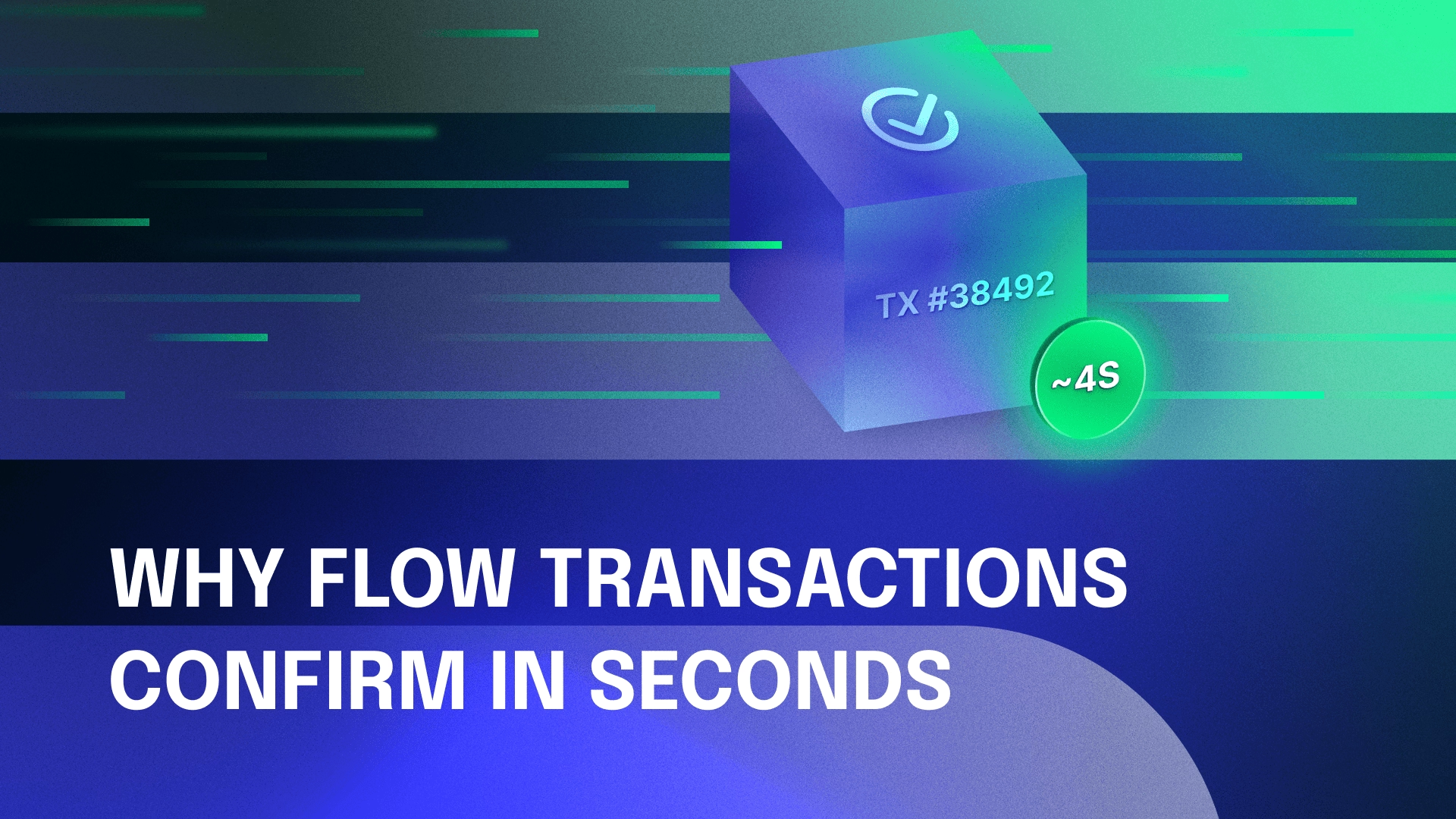
On Ethereum, you're waiting about 13 minutes. On most L2s, true finality can take a day or even a week. On Flow, you get cryptographically-backed soft finality in ~4 seconds and irreversible hard finality in ~10 seconds. By achieving finality this quickly, Flow minimizes the "window of uncertainty" where transactions are vulnerable to reorganization or disputes, ensuring that trust is established through immediate, verifiable proof rather than long waiting periods.
That 4-second soft finality is what most apps should build around. Unlike "optimistic" confirmations on other chains, Flow's soft finality comes with real economic guarantees - if the result is wrong, nodes get slashed. For the vast majority of use cases, this is more than enough certainty to update your UI and move on.
This isn't a minor UX improvement. It fundamentally changes what you can build.
What is Finality?
Finality is the guarantee that a transaction cannot be reversed, reorganized, or rolled back. It's the point at which you can trust the blockchain's answer without reservation.
Think of it like a credit card transaction. The vendor sees "approved" instantly, but chargebacks can occur for weeks. The instant approval is a preliminary result. True settlement happens later. Blockchains work similarly - you might get a quick response, but that doesn't mean the transaction is final.
The Three Stages of Finality
In Proof-of-Stake blockchains, finality progresses through three stages:
1. Preliminary Result
An initial answer with no economic guarantees. If the node providing this result lies or is wrong, there's no penalty. This is what you get from optimistic systems before verification.
2. Soft Finality (Economic)
The answer is backed by cryptographic proof. If the node providing it is wrong or deceptive, they get slashed (lose staked funds). On Flow, this is the "Executed" status.
3. Hard Finality (Economic)
The answer is either true, or the entire blockchain needs to restart. At least one-third of validators would need to be slashed for this to be wrong. On Flow, this is the "Sealed" status.
How Flow Compares
Flow is unique in that it bypasses preliminary results entirely. When a Flow Access Node tells you a transaction has been executed, that statement is backed by cryptographic proof. If the node is lying, there's evidence that can lead to slashing.
For most applications, the ~4 second soft finality is the number that matters. This is when you should update your UI, show the user their new balance, or confirm their NFT purchase. The additional ~6 seconds to hard finality is only necessary for extremely high-value operations where you need absolute irreversibility.
What About L2s?
Layer 2 solutions like Arbitrum, Optimism, and zkSync achieve fast optimistic finality, but true settlement depends on the underlying L1.
- Optimistic rollups (Arbitrum, Optimism): 7-day challenge period before withdrawals to L1 are final
- ZK rollups (zkSync): Typically 1-24 hours for proof generation and L1 settlement
When an L2 shows your transaction as "confirmed," that's a preliminary result. The sequencer says it's included, but the L1 hasn't verified it yet. For most use cases this is fine, but for high-value DeFi operations, you're trusting the sequencer until L1 finality.
Flow doesn't have this two-tier system. Finality on Flow is finality, period.
Why This Matters
For DeFi
In DeFi, finality determines when you can trust a swap, a loan, or a liquidation. With 13-minute finality on Ethereum:
- Arbitrageurs face execution risk on cross-protocol strategies
- Lending protocols need larger safety margins for liquidations
- Users can't be certain their transaction won't be reorged
With 10-second finality on Flow:
- Complex multi-step operations settle quickly
- Lower capital requirements for time-sensitive operations
- What you see is what happened
For User Experience
When a user completes an action in your app, how long until you can show them the confirmed result?
- Ethereum: Wait 13+ minutes for certainty, or show optimistic UI and hope
- L2s: Show fast optimistic confirmation, explain the 7-day withdrawal delay later
- Flow: Show a cryptographically-backed result in ~4 seconds
This changes how you design interfaces. On Flow, you can wait for soft finality and confidently update your UI - the result is economically guaranteed. There's no need to show spinners for 13 minutes or cross your fingers that an optimistic result won't be reverted.
Build your UI around the 4-second soft finality. Reserve the 10-second hard finality check for settlement of large trades or other operations where you need the absolute strongest guarantee.
For Cross-Chain Operations
Bridges and cross-chain protocols inherit the finality of their slowest chain. If you're bridging from Ethereum, you're waiting for Ethereum finality regardless of how fast the destination chain is.
Flow's fast finality means bridges to Flow can confirm quickly. And with Flow EVM running within the same protocol, moving assets between Cadence and EVM is atomic - no bridge delay at all.
How Flow Achieves Fast Finality
Flow's speed comes from its multi-role architecture, not from compromising on decentralization:
1. Separation of Concerns
Flow splits node responsibilities across specialized roles:
- Collection Nodes: Batch transactions into collections
- Consensus Nodes: Order transactions and form blocks
- Execution Nodes: Compute transaction results
- Verification Nodes: Check execution correctness
This parallelization allows the network to process transactions faster without requiring every node to do everything.
2. Pipelined Execution
While one block is being executed, the next block is undergoing consensus, and a third is being collected. This assembly-line approach maximizes throughput without sacrificing security.
3. Deterministic Finality
Flow doesn't use probabilistic finality like Bitcoin (where you wait for more blocks to be "more sure"). Once a block is sealed, it's final. The protocol guarantees it.
Finality in Practice
Here's what the developer experience looks like:
// Using FCL (Flow Client Library)
import * as fcl from "@onflow/fcl"

// Send a transaction
const txId = await fcl.mutate({
  cadence: `
    transaction {
      execute {
        log("Hello, Flow!")
      }
    }
  `,
})

// Wait for execution (soft finality) - ~4 seconds
// This is what most apps should use!
const executed = await fcl.tx(txId).onceExecuted()
console.log("Executed:", executed.status)

// Update your UI here - the result is cryptographically guaranteed
updateUserBalance()
showSuccessMessage()

// Only wait for sealing if you really need hard finality
// (large value transfers, settlement, etc.)
const sealed = await fcl.tx(txId).onceSealed()
console.log("Sealed:", sealed.status) // ~10 seconds total
Use onceExecuted() for your UI. This is the recommended pattern for most applications. The ~4 second soft finality is backed by cryptographic proof and economic guarantees - it's not just an optimistic guess.
Reserve onceSealed() for cases where you need the absolute strongest guarantee: settling large trades, finalizing withdrawals to external systems, or other high-stakes operations where the extra ~6 seconds is worth the additional certainty.
The Bottom Line
Finality isn't just a number to put in a comparison chart. It determines:
- How quickly users see confirmed results
- How much risk DeFi protocols carry between transactions
- How complex your error handling and reorg protection needs to be
- Whether "optimistic" confirmations are good enough for your use case
Flow gives you cryptographically-backed soft finality in ~4 seconds - that's what you should build your UI around. Hard finality follows in ~10 seconds total for operations that need absolute irreversibility.
Compare that to Ethereum's 13+ minutes or L2s' week-long settlement delays. On Flow, you can wait for real confirmation and still have a snappy user experience. No optimistic assumptions, no challenge periods, no hoping the sequencer was honest.
When a Flow transaction is executed, it's confirmed. When it's sealed, it's settled. Both happen fast enough to build great user experiences around.