
FLOW CREDIT MARKET MEMO
Active Rebalancing Infrastructure for Next-Generation DeFi Lending
Executive Summary
Flow Credit Markets (FCM) solves the fundamental dilemma of traditional DeFi lending: capital efficiency vs. liquidation risk. In traditional lending protocols, even simple borrowing is a risky activity where market volatility demands excessive collateral buffers, locking away value that could otherwise be productive. FCM fundamentally inverts this by continuously adjusting your positions, buying and selling investment assets to maintain ideal leverage.
In simple terms: FCM allows you to increase your returns, while dramatically reducing the risk of liquidation.
Structural Advantages
FCM delivers three distinct structural advantages over traditional DeFi lending:
- Enhanced Capital Efficiency: Standard protocols rely on reactive liquidation mechanisms that require wide safety margins to account for volatility, forcing conservative Loan-to-Value (LTV) limits. FCM replaces this with automated rebalancing. By managing risk through frequent, automated adjustments rather than large liquidation events, the protocol safely supports significantly higher LTV ratios. This allows users to deploy a larger percentage of their assets into productive strategies.
- Principal Protection: FCM acts as an automated risk manager by leveraging fully automated, on-chain scheduled transactions on the Flow blockchain. If collateral depreciates, the system is programmed to sell the investment rather than the underlying collateral to pay down debt (Defensive Rebalancing). This preserves the user's core principal during market downturns. Conversely, if collateral appreciates, the system automatically reinvests the excess equity to compound returns (Investment Compounding).
- Cost Optimization: Leveraged DeFi strategies are often constrained by the high cost of borrowing external stablecoins, where utilization rates drive up interest. FCM mitigates this through its Medium of Exchange Token (MOET), which functions as a protocol-native settlement layer. This decouples borrowing costs from external stablecoin market dynamics, enabling FCM to offer structurally lower borrowing rates.
Protocol Architecture
FCM is composed of three intertwined systems that work together to dynamically adjust token balances based on market conditions:
Flow Active Lending Protocol (Flow ALP)
The Flow ALP fundamentally reimagines lending infrastructure by shifting from a reactive liquidation model to a proactive, automated rebalancing model. Existing protocols force you to overcollateralize heavily, locking up capital in massive, inefficient "safety margins", while risking liquidation in the event of large price swings in your collateral.
Established protocols treat your initial loan parameters as a static baseline. Unless you manually tune your position to react to market changes, you must accept poor capital efficiency. FCM introduces a paradigm shift: it treats your ideal leverage as a dynamic target, acting as an autonomous portfolio manager that adjusts your balances automatically. When the value of your collateral decreases, Flow ALP rebalances your position to protect your collateral and avoid liquidation. When the value of your collateral appreciates, Flow ALP proactively reinvests the excess equity. Powered by Flow's native scheduled transactions, operating much like a reliable cron daemon on a Linux server, Flow ALP continuously monitors and adjusts your position without external triggers.
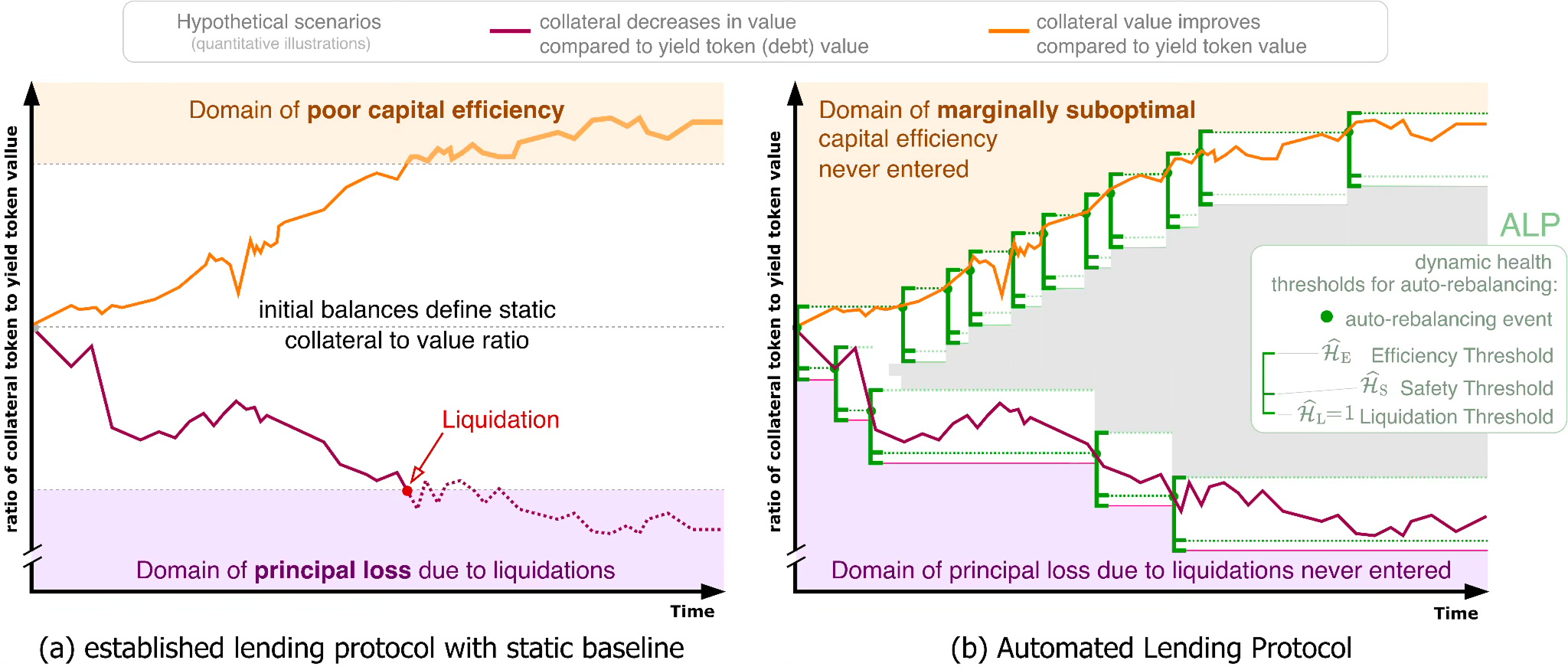
Figure 1: Static Baseline vs. Automated Lending Protocol. Conventional lending protocols (a) require large, static LTV safety margins (white area) to shield against liquidation, locking up capital and diminishing efficiency. In contrast, FCM’s Automated Lending Protocol (b) operates with drastically narrower safety margins. By continuously and automatically rebalancing user positions, FCM eliminates the need for crude, drastic balance changes, maximizing capital efficiency while simultaneously protecting the principal from liquidation.
Dynamic Health Scoring
Rather than a rigid Loan-to-Value (LTV) limit, Flow ALP constantly calculates a real-time ‘Health Factor’ for every position. This measures the value of a user's deposited collateral against their active debt, intelligently adjusted for the specific volatility of those assets.
Tri-Level Health Management
To algorithmically fine-tune positions, Flow ALP utilizes a sophisticated three-tier threshold system to automatically keep your leverage in the optimal zone:
- Efficiency Threshold ( ℋE ): The point where your position becomes overly conservative. If you have too much collateral sitting idle, the protocol puts that capital to work by dynamically borrowing more investment assets.
- Target Health ( ℋT ): This represents the optimal balance of high capital efficiency and robust safety. Whenever the protocol steps in to adjust your position (either buying or selling), it aims to reset your portfolio precisely to this target baseline.
- Safety Threshold ( ℋS ): The critical early-warning buffer. If market turbulence causes your collateral value to drop to this line, the protocol intervenes before you face a catastrophic liquidation. It preemptively sells just enough of your yield-bearing investment to pay down debt, preserving your underlying principal and instantly restoring your position to the safe target zone.
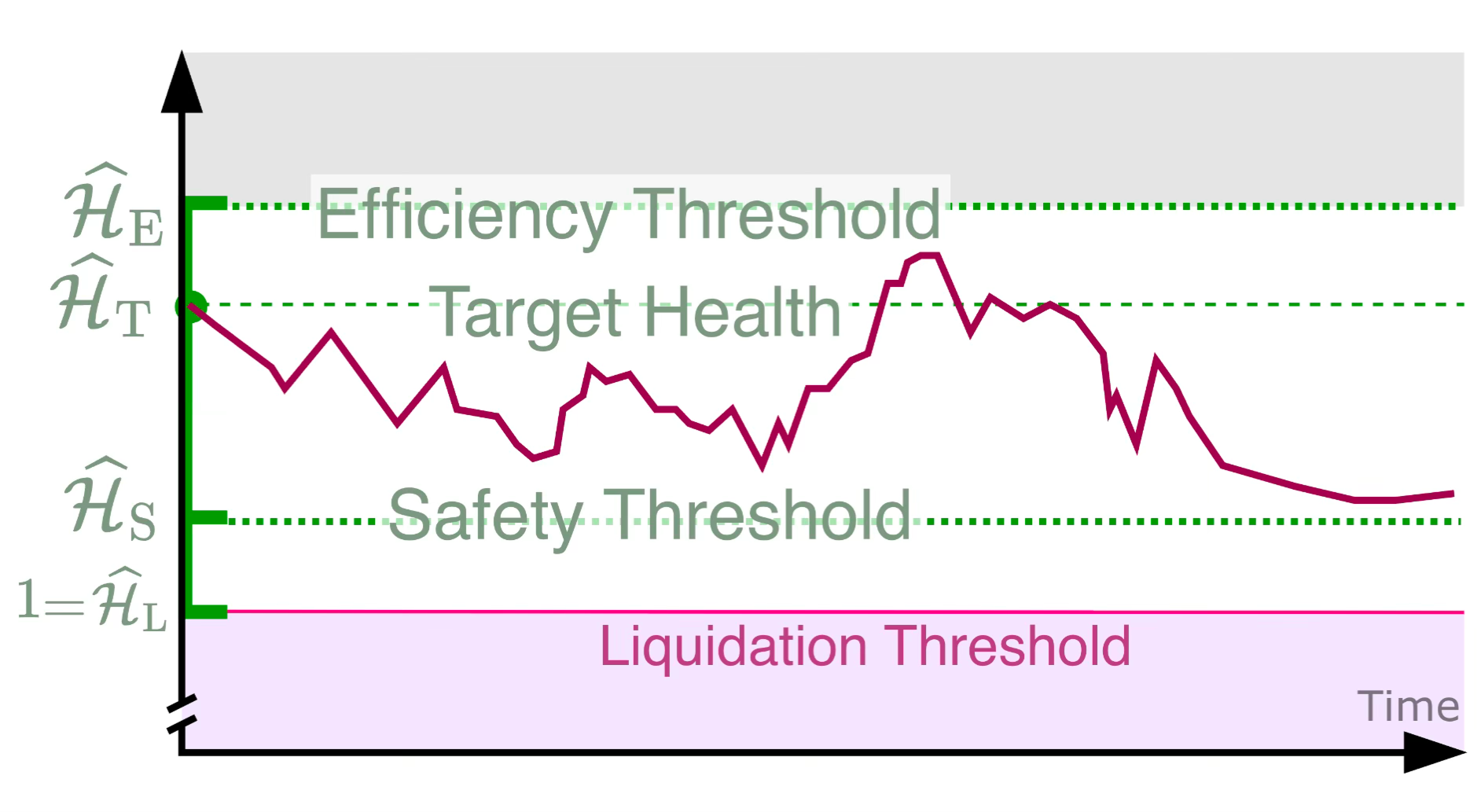
Figure 2: Tri-Level Health Management Policy. An illustration of whenever a position exceeds the Efficiency Threshold or drops to the Safety Threshold, Flow ALP automatically rebalances the position towards the Target Health factor.
Flow Yield Vaults (FYV)
Flow Yield Vaults represent the flagship implementation of FCM's active rebalancing technology.
- Automated Yield Strategies: FYV creates a three-asset relationship: collateral, MOET debt, and yield token investment.
- Dual Position Management: The system leverages a two-tier health monitoring system. The Protocol Layer (Flow ALP) monitors the collateral-to-MOET debt ratio for base layer solvency protection, while the Vault Layer executes rebalancing through yield token sales to optimize yield.
- Yield Token Integration: FYV supports both cross-chain yield tokens and Flow-native tokenized yield products. The system's flexibility allows for diverse yield strategies while maintaining consistent rebalancing mechanics regardless of underlying yield source.
Medium of Exchange Token (MOET)
MOET is the core stable asset of the FCM Protocol, engineered to unify liquidity, streamline treasury management, and provide a robust unit of account.
- Dual-Backing Model: MOET is always fully backed, either by a 100% reserve of approved stablecoins or by other approved assets at a minimum 125% collateral ratio.
- Stability Mechanisms: Value stability is maintained through a diversified basket of backing assets, automated interest rate adjustments to incentivize minting or repayment, and algorithmic arbitrage facilitators.
Built on Flow
The unique properties of the Flow Blockchain provide critical capabilities that make FCM's autonomous lending system possible:
- Scheduled Transactions: Unlike other blockchains that depend on third-party bots, Flow supports native scheduled transactions, allowing apps like FCM to autonomously execute functions 100% on-chain.
- Fair Execution (MEV-Resistance): Users and node operators cannot pay for priority or manipulate transaction order. Transactions on Flow are executed fairly, eliminating the risk of users losing their spot in line or facing MEV risk from third parties.
- Advanced Composability: Transactions on Flow can be constrained to strict pre and post conditions; if conditions are not met, the transaction safely reverts as though nothing happened, ensuring complex transactions involving multiple smart contracts can occur without risk of bugs or errors to the user.
Conclusion
Flow Credit Markets represents a fundamental advancement in DeFi lending infrastructure, demonstrating that active rebalancing can eliminate most liquidation risks that have constrained lending protocol adoption. This combination of technical innovation, autonomous risk management, and the unique capabilities of the Flow blockchain establishes FCM as a transformative force in decentralized lending and consumer finance.